
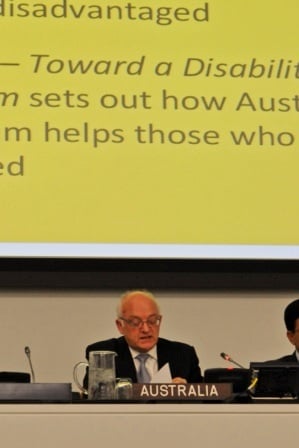
 Australia's National Voluntary Presentation given by The Honourable Mr Bob McMullan MP, Parliamentary Secretary for International Development Assistance to the United Nations Economic and Social Council on 1 July 2010.
(as delivered)
It is an honour to give this National Voluntary Presentation on behalf of the Australian Government. I would like to acknowledge the representative of Portugal; João Gomes Cravinho, Secretary of State for Foreign Affairs and Cooperation, of Timor Leste; Her Excellency Ms Sofia Borges; and Papua New Guinea; His Excellency Mr Robert Aisi. These are important partners in tackling the shared challenge of development in Australia’s region.
I look forward to hearing their views at the end of my remarks.
Australia has an ambitious approach to international development. We have in recent years built a bigger and better aid program and we have ambitions to go further in the future. Our ambition reflects the optimism and commitment of leaders who selected the Millennium Development Goals in 2000.
In my presentation today I will outline some of the tangible things that Australia – working with partner Governments – has achieved in gender equity. But first I want to briefly explain my remark about ambition – to talk about the macro situation for Australian aid.
Australian aid overview
In 2005, Australia made a commitment to double our aid program by 2010 and we have met that commitment. Furthermore, Australia expects to more than double our aid program again in the next five years.
Australia is in a strong position among OECD countries because our economy has evaded the worst effects of the global financial crisis and has continued to grow. Despite the challenges of a tight government budget, Australia will increase development assistance by 14 per cent in the coming budget year. Few countries will achieve such growth in aid expenditure.
Australian ambition in the aid realm has also lead us to expand the reach of our aid. We have more than doubled aid to Africa in the last three years. We have started new programs in the Caribbean and Latin America. In these places, we will work closely with other donors and ensure we focus on areas where we bring specific expertise.
For example, we feel we can bring unique skills to Africa in agriculture because in Australia we have experience in dry-land and semi-arid farming. In the Caribbean we can share our experience in working with Pacific small island states and help transfer development lessons between these two regions.
We are increasing our assistance to South Asia, particularly to Bangladesh and to conflict affected populations in Sri Lanka and Nepal.
In Afghanistan, our development assistance continues to grow. In 2010-11, Australia will deliver approximately $106 million through the aid program to help build the capacity of the Afghan Government to deliver basic services to its people, especially in Uruzgan, one of the poorest provinces in Afghanistan.
Given our location in the Asia Pacific, the majority of our aid will continue to concentrate on our region.
We will intensify our efforts on aid effectiveness and value for money. Like other countries, support for aid depends on public confidence. Maintaining public confidence requires us to deliver results that are value for money.
I would like to mention just two recent measures that drive effectiveness. First, last month the Australian Government announced a review of the role of technical advisers in the aid program. The review will look at the requirement for each adviser position in all countries, starting with four programs – Papua New Guinea, East Timor, Solomon Islands and Vanuatu. The review will help us ensure that each adviser is the correct response to the jointly identified need, and that each position represents good value for money.
The second measure to drive effectiveness is the Pacific Partnerships for Development. These were launched by the then Prime Minister Rudd in 2008. These Partnerships aim to achieve a number of key things:
- they align our aid with partner systems and priorities
- they are rooted in mutual respect and mutual responsibility
- they aim to make faster progress towards achieving the MDGs.
Australia is the largest bilateral donor to the Pacific region. This year we expect to spend over $1 billion on development assistance for Papua New Guinea and the Pacific.
We also helped construct the Cairns Compact on Strengthening Donor Coordination agreed by Pacific Leaders in 2009. The Compact is driving coherent, streamlined approaches to how we use scarce development resources.
This drive for effectiveness will be an increasing focus of Australian aid as we scale up our efforts over the coming five years; we will do so in a measured way – supported by continued development of our planning systems, operational approaches and reporting systems.
Development for All
Before I move onto Gender, I’d like to talk more broadly about equity, which has been given a greater prominence in the Australian aid program in recent years. We use the phrase development for all and we mean it when we say it. This means we increasingly target the most disadvantaged groups — the very poor, women and children, ethnic groups, those living in rural and remote areas, those affected by conflict, people with disability.
In relation to this last group I would draw your attention to our five year strategy Development for All – Towards a Disability Inclusive Aid Program. Australia is one of very few countries to have an explicit policy on how to assist the doubly disadvantaged – those who live in poverty and live with a disability. This is something unique and so I wanted to draw it to your attention.
It is my view that donors such as Australia can play an important role to raise what I call “un-voiced” development issues. By this I mean issues such as mental health, coping with ageing populations and confronting non-communicable diseases such as diabetes.
Gender
Let me now turn specifically to gender. I will try not to cover the ground already covered by previous speakers and I want to give you a few examples of Australia’s approach.
A few principles to begin. Gender equality makes sense. When girls have equal access to education it lowers birth rates, reduces maternal mortality, and improves the health of their children. When women as well as men have access to economic opportunity it helps their families prosper, and the country grow. When women as well as men participate in decision-making it leads to more inclusive and responsive decisions being made.
Women have half the world’s talent and we should all use it.
Achieving gender equality is a challenge and one which we continue to pursue in Australia. In several indicators of gender equality, for example in health and education, Australia is now ranked close to the top in the world.
Leadership
We have seen in Australia that when women have come together to exert an influence on policy formulation and decision-making it improves all of our lives.
You may be aware that last week Australia appointed its first female Prime Minister. Our Governor General (the equivalent of a head of state) is also a woman – and, for those living in Queensland or New South Wales their State Premiers are also women.
Even for a developed country like Australia we consider this to be an achievement in equality. It took Australia decades to make this progress; we hope to see similar changes in developing countries much more quickly.
Good leadership is crucial in developing and developed countries alike. We need highly trained leaders to accelerate progress towards the MDGs.
Australia’s Development Awards give the best and brightest individuals from developing countries the opportunity to increase their knowledge and establish global networks.
We are expanding the number of development scholarships. In Africa, for example, we will offer 1000 long and short term scholarships a year across Africa by 2012–13. The awards will respond to partner government priorities and help strengthen Africa’s leadership capacity.
As a priority, Australia will increase the number of women in the next generation of leaders by promoting gender parity in development awards.
We are helping strengthen women’s leadership and representation in Parliament in the Pacific and Papua New Guinea. One of our programs is training women on how to run for public office and educating voters and electoral commissions on why it’s important for women to have a fair go at being elected.
Violence against women
We have acted in our region in very practical ways. In Papua New Guinea this year Australia committed $75 million to activities to support efforts in reducing violence against women. This includes support to shelters for women affected by violence – such as Haus Ruth in Port Moresby.
Australian programs provide better access for women to the legal process through village courts.
In Papua New Guinea the number of female village court magistrates has increased from just 10 in 2004 to 283 by the end of 2009. Many village cases are about domestic issues relating to divorce, family matters and violence. These issues affect women so it’s sound thinking to have a large proportion of women hearing these cases. This gives women more confidence to come forward with their matters.
In Timor Leste Australia supported a community based education program with the Association of Men Against Violence. The program raises awareness to change the behaviour of men and youth toward women. Australia also supported the Fiji Women’s crisis centre over six years to assist survivors of violence and advocate for women’s rights in countries across the region.
Education
I’m proud of some of our broader achievements in development, which will achieve other MDGs but will also tangibly benefit women and children.
Education is the flagship of the Australian aid program.
Women and girls represent two thirds of the almost one billion people globally who lack basic literacy skills, and children with disability are especially disadvantaged.
Our partnership with Papua New Guinea is promoting faster progress toward basic education by supporting the government’s Universal Basic Education Plan. This ambitious – but achievable – plan aims for 70 per cent primary school enrolment by 2015.
In Indonesia, Australian support for a program to build 2000 schools is nearing completion. Girls account for more than 50 per cent of the 70,000 new students in these new schools. This will enable more than 330,000 children to access a quality basic education through state and Islamic junior secondary schools in Indonesia. The schools have been designed to be disability-inclusive.
In Laos, Australia is supporting new ways to bring education to ethnic groups in remote areas, for example through mobile classrooms.
Access to proper water and sanitation facilities in schools is vital if girls are to be encouraged to attend school. In Laos, Australia is also supporting a program that in 2009 constructed 125 new schools in the most remote and impoverished areas. Improved school environments have facilitated increased attendance by girls through the construction of separate toilets and provision of an adequate water supply. Overall attendance has increased by 5% and repetition rates for girls has declined by over 10% in just two years.
Australia is working in Solomon Islands to ensure that access to appropriate water and sanitation facilities are available in schools. We have committed $11.0 million from 2010 11 to 2013 14 under the Solomon Islands Access to Clean Water Supply and Sanitation Initiative. This includes ensuring schools have appropriate water and sanitation facilities and aims to show communities the importance of well designed sanitation in overcoming gender and cultural barriers.
Health
Improving maternal and child health is also critical to development outcomes for women and girls. We are deeply concerned about lagging progress on MDGs 4 and 5. We will work with developing countries to deliver vital health services, and we will work to improve the performance of health systems in important areas such as financing, procuring medicines and training of nurses and midwives.
This means that more women will be supported by skilled health professionals when giving birth and will have access to health care services during their pregnancies.
In Ethiopia, with Australian funding and support, the Addis Ababa Fistula Hospital is providing 3,000 services a year to expectant mothers, with access to trained midwives and health services. The hospital’s midwifery college is training young Ethiopian women to be skilled midwives. We think this is a best-practice model and we are confident this model can be applied in other parts of Africa.
The new family planning guiding principles for the Australian aid program seek to provide the same range of reproductive health and family planning services for women in developing countries as are supported for women in Australia, subject to the laws of the relevant nation concerned.
Support for family planning is one of the most effective interventions to increase the spacing between births. This reduces maternal deaths and leads to healthier mothers and healthier children.
Australia is working with the government of Timor Leste providing $23million over four years from 2008 to train 54 midwives to provide family planning services, and to give advice through monthly clinics. The number of births attended by skilled health workers has risen from 18% in 2003 to 30% in 2009. This is still far too low, but it is nevertheless a solid achievement by the Government of Timor Leste and we’re proud to have played a part.
Conclusion
Let me conclude by noting we face a long term and a major challenge. Despite our achievements and our ambition, we still have a long way to go. We know that gender equality is central to economic and human development in a country. We know that the benefits are not just for today’s women and their families, and their communities, but for all the generations that will follow them in the future. This is the goal of MDG3, and is also central to the achievement of all the other MDGs.
Australia is committed to working with our partners to help them promote gender equality and empower women. We’ll do this with what I am confident will be an ambitious, a bigger and a more effective aid program.
Thank you